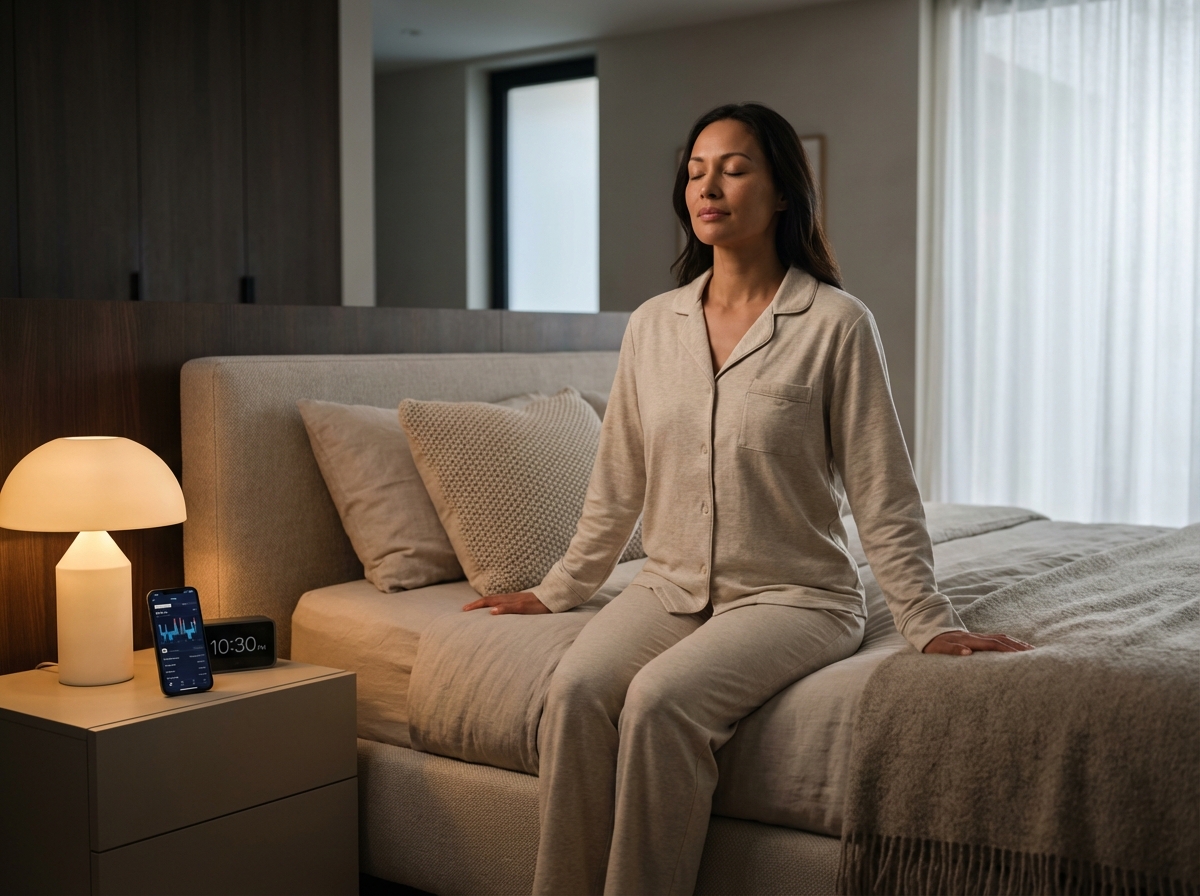
Struggling to fall asleep and stay asleep? This article examines the 4-7-8 breathing method alongside proven insomnia strategies including CBT-I, bedtime routines, and lifestyle changes. You’ll learn how the breathing exercise works, what the evidence shows, when it helps or doesn’t, and how to integrate it into a practical plan to get deeper, more restorative sleep.
Why falling asleep is hard and where the 4-7-8 method fits
Falling asleep should be a natural transition from wakefulness to rest. For many adults in the United States, this process feels more like a frustrating battle. Recent statistics suggest that nearly 30 to 40 percent of the population deals with insomnia symptoms at some point during the year. About 10 percent of these individuals face chronic insomnia, a condition defined by trouble sleeping at least three nights a week for three months or longer. The physiology of sleep onset requires a specific shift in the nervous system: your heart rate must slow down, your core body temperature needs to drop, and most importantly, your brain needs to move from the high-alert sympathetic state into the calm parasympathetic state.
The primary obstacle for most people is hyperarousal. This is a state where the body remains stuck in “fight or flight” mode long after the day has ended. Stress hormones like cortisol stay high, keeping the brain scanning for threats or ruminating on problems. In the USA, this is often exacerbated by circadian misalignment. We spend our evenings under bright blue light from smartphones and tablets. Research from Harvard indicates that this exposure can shift melatonin production by two to three hours. When you add poor habits like late-afternoon caffeine or using alcohol to “unwind,” the biological path to sleep becomes blocked. Alcohol is particularly deceptive; it might help you fall asleep faster, but it fragments your sleep architecture, often reducing REM sleep by significant margins.
This is the context where the 4-7-8 breathing method has gained significant traction. Popularized by Dr. Andrew Weil at the University of Arizona, its foundations are much older. The technique is rooted in pranayama, an ancient yogic practice of breath control dating back to 1500 BCE. Dr. Weil introduced this specific 4-7-8 ratio as a way to hack the nervous system and induce a state of deep relaxation.
The Core Steps of the 4-7-8 Method
The technique is simple to learn but requires precision in its execution. The specific ratio is designed to maximize the activation of the vagus nerve, acting more like a natural tranquilizer for the nervous system than a simple relaxation exercise. You can sit with a straight back or lie down in bed. Place the tip of your tongue against the ridge of tissue just behind your upper front teeth and keep it there through the entire exercise.
The 4-7-8 Sequence:
- Exhale: Part your lips slightly and exhale completely through your mouth, making a whoosh sound.
- Inhale (4 counts): Close your mouth and inhale quietly through your nose for a mental count of 4.
- Hold (7 counts): Hold your breath for a count of 7.
- Exhale (8 counts): Exhale completely through your mouth, making a whoosh sound to a count of 8.
This completes one cycle. Dr. Weil recommends starting with four cycles per session. The goal is not to hold your breath until you feel uncomfortable, but to maintain the specific ratio of 4-7-8. If you find the counts too long, you can speed them up as long as the proportion remains the same (e.g., 2-3.5-4).
Safety and Adaptations
While generally safe, certain groups need to adapt the method. The most common side effect for beginners is light-headedness, usually due to the change in carbon dioxide levels. This typically passes with practice. However, specific precautions apply:
- Older Adults: May feel lightheaded with a seven-second hold. A shortened ratio (3-5-6) can maintain benefits without dizziness.
- Pregnancy: Pregnant individuals, especially in the third trimester, should consult their doctor and avoid long breath holds.
- Respiratory Conditions: People with COPD or severe asthma must be cautious. Forced exhalation or long holds can trigger breathlessness. If you have a history of respiratory distress, consult a clinician before starting.
- Heart Conditions: If you have heart disease, monitor yourself for dizziness. Stop immediately if you feel faint.
The Science: Vagus Nerve and Heart Rate Variability
The physiological theory behind this practice focuses on the vagus nerve, the command center for your parasympathetic nervous system. By intentionally slowing your respiration rate from the usual 12 to 20 breaths per minute to about 4.5 cycles per minute, you send a physical signal to your brain that you are safe. This reduces sympathetic arousal.
Research into the 4-7-8 breathing method has grown more specific. A 2022 study published in Global Advances in Health and Medicine examined the effects of this method on heart rate variability (HRV). The researchers found that the 4-7-8 control significantly increased high-frequency power in HRV, indicating a clear shift toward parasympathetic dominance. The study noted a decrease in heart rate by about 6 beats per minute and a drop in systolic blood pressure by 5 to 10 mmHg after just one session. Even sleep-deprived individuals saw a drop in blood pressure.
| Metric | Before 4-7-8 Practice | After 4-7-8 Practice |
|---|---|---|
| Average Heart Rate | 72-80 bpm | 64-72 bpm |
| Systolic Blood Pressure | Baseline | Decrease of 5-10 mmHg |
| Respiration Rate | 12-18 breaths/min | 4-6 breaths/min |
| Vagal Tone | Lower | Increased (HF-HRV) |
Comparing 4-7-8 to Other Relaxation Techniques
Understanding how 4-7-8 differs from other methods helps clarify its specific role:
- Diaphragmatic Breathing: Focuses on deep belly expansion without a specific count. Good for general stress, but lacks the rhythmic rigor of 4-7-8.
- Paced Breathing: Usually involves equal lengths for inhalation and exhalation (e.g., box breathing). This balances the nervous system, whereas 4-7-8 emphasizes the exhale to sedate the system.
- Progressive Muscle Relaxation (PMR): Involves tensing and releasing muscle groups. This addresses physical tension directly, whereas 4-7-8 targets the autonomic nervous system.
Realistic Expectations and Integrating with CBT-I
There is anecdotal evidence suggesting this method can put you to sleep in sixty seconds. While popular on social media, scientific evidence for such an immediate effect is limited. For most people, the 4-7-8 method is a tool for reducing sleep latency (the time it takes to fall asleep) rather than a magic switch. In untreated insomniacs, latency often averages 45 minutes. Using breathing exercises as an adjunct can help lower this time, but it is rarely a standalone cure for severe chronic insomnia.
It is helpful to compare breathing exercises with broader strategies like Cognitive Behavioral Therapy for Insomnia (CBT-I). CBT-I is currently the gold standard for treatment, addressing the psychological and behavioral roots of sleep disorders. While 4-7-8 breathing can lower your heart rate, CBT-I works to restructure your entire relationship with sleep. Meta-analyses show that CBT-I can reduce sleep latency to an average of 19 minutes. Breathing exercises are most effective when included in these protocols as a relaxation component, helping to manage the physical hyperarousal that makes techniques like stimulus control difficult.
Practical Implementation: A 6-Week Roadmap
The 4-7-8 method is a cumulative skill. You might not feel a profound change the very first time you try it. Dr. Weil emphasizes that real benefits appear after several weeks of consistent use. Use the following plan to integrate this practice into your life.
Weeks One and Two: Mechanics
Focus on the mechanics of the breath. Practice four cycles of 4-7-8 twice a day: once in the morning to set a calm tone, and once about an hour before bed. Do not worry about falling asleep instantly. Just focus on the “whoosh” sound during the eight-second exhale.
Weeks Three and Four: Application
Start using the technique during middle-of-the-night awakenings. If you wake up at 3 AM with a racing mind, perform four cycles while lying on your back. This can pull you out of a spiral of anxiety. Combine this with stimulus control: if you are still awake after twenty minutes, get out of bed and do a quiet activity in dim light.
Weeks Five and Six: Evaluation
By this stage, the breathing should feel natural. You might notice that your heart rate drops more quickly than it did in week one. Evaluate your progress using a sleep diary.
Structuring Your Day for Sleep
Integrating 4-7-8 into a broader lifestyle plan is the most effective way to beat insomnia. Use the following template to structure your day.
| Time of Day | Action Step | Purpose |
|---|---|---|
| 12:00 PM | Caffeine Cutoff | Prevents adenosine receptor interference |
| 4:00 PM – 8:00 PM | Moderate Exercise | Boosts deep sleep and lowers sleep latency |
| 7:00 PM | Last Large Meal | Reduces sleep fragmentation from digestion |
| 9:00 PM | Alcohol Cutoff | Prevents middle of the night awakenings |
| 10:00 PM | Screen Power Down | Allows natural melatonin production |
| 10:30 PM | 4-7-8 Breathing | Activates parasympathetic nervous system |
| 11:00 PM | Lights Out | Consistent sleep window |
Tracking Your Progress
To know if the 4-7-8 method is helping, track specific metrics using a sleep diary or a wearable device. Actigraphy from wrist devices is generally accurate within ten to twelve minutes for sleep latency.
| Metric to Monitor | Target Goal | Why It Matters |
|---|---|---|
| Sleep Latency | Under 30 minutes | Shows how fast you transition to sleep |
| Wake After Sleep Onset | Under 20 minutes | Measures the quality of sleep maintenance |
| Sleep Efficiency | Above 85 percent | The ratio of time asleep to time in bed |
If you do not see a 20 percent improvement in your sleep metrics after four to six weeks, it is time to escalate to professional care. Chronic insomnia can sometimes be a symptom of sleep apnea or restless leg syndrome, which require medical diagnosis. You can search the American Academy of Sleep Medicine directory to find a certified clinician.
Beyond Sleep: Anxiety and Panic
Beyond the bedroom, this technique is often recommended for managing anxiety and panic disorders. The long exhale stimulates the vagus nerve, providing a portable tool you can use anywhere. The Ohio State Medical Center includes 4-7-8 breathing in its evidence-based mindfulness programs. If you feel a panic attack starting, the rhythmic counting can provide a mental anchor, while the physiological shift lowers overall anxiety levels over time.
Sources
- Effects of sleep deprivation and 4‐7‐8 breathing control on heart … — The 4‐7‐8 breathing control, which is based on an ancient yogic technique called pranayama, aims at reducing anxiety and facilitating easier …
- 4-7-8 breathing: How it works, benefits, techniques, and uses — There is limited scientific research to support this method, but there is a lot of anecdotal evidence to suggest that this type of deep, rhythmic breathing is …
- How the 4-7-8 Breathing Technique Can Help Reduce Stress — The 4-7-8 breathing technique offers a simple method for helping people with eczema reduce stress and the likelihood of a flare, while helping to regulate the …
- Just Breathe: Using Breathwork for Wellbeing — By inhaling for 4 seconds, holding the breath for 7 seconds, and exhaling for 8 seconds, this method helps regulate the nervous system and can …
- Breathe Easy, Present Confidently: Mastering the 4-7-8 Breathing … — The 4-7-8 breathing technique, rooted in ancient yogic practices, has gained popularity as a simple yet effective method for managing stress and anxiety.
- 4-7-8 breathing for anxiety | Ohio State Medical Center – YouTube — … breathing technique to calm anxiety effectively. This demonstration is part of the Mindfulness in Motion program, an evidence-based, eight …
- 3 breathing exercises to relieve stress – BHF — While there isn't much scientific research on 4-7-8 breathing, people say it helps them to cope with stress and to fall asleep more quickly.
- Breathing Brings Benefits Infographic – American Heart Association — Discover the power of deep breathing with our infographic Breathing Brings Benefits. Learn how simple techniques like 4-7-8 breathing can reduce stress, …
Legal Disclaimers & Brand Notices
The content provided in this article is for informational and educational purposes only and does not constitute medical advice, diagnosis, or treatment. Always seek the advice of your physician or another qualified healthcare provider with any questions you may have regarding a medical condition, especially before attempting new physical techniques if you have underlying respiratory or cardiovascular concerns.
All product names, logos, and brands are property of their respective owners. All company, product, and service names used in this article are for identification purposes only. Use of these names, trademarks, and brands does not imply endorsement.